Text hooks are the piece of a short-form video that most creators treat as decoration and most retention data treats as the single input deciding how far the reel travels. For a viewer watching on mute, the first-frame overlay is the hook, and the audio is a bonus.
Source: The core tactic (transcript to Claude, prompt-driven text-hook generation) is what we've been running internally for months and what two paying customers, Jack from Clinic Mastery and Kyle from Iron Productions, independently described in demo calls this week. The prompt structure below is ours, built around clear first-frame promises, transcript-grounded claims, and the first-frame mechanics playbook by Dominik. The editorial layer on top (why archetype selection matters and how to steer your caption workflow off the same transcript) is ours.
The 3-second retention gap is mostly a text-overlay problem
A reel that loses people before the point has little chance to teach anything. Three-second retention is one useful way to see whether the opening earned attention. Compare it across your own posts, alongside watch time and the responses you care about, rather than treating any percentage as a universal threshold.
On-screen text gives a muted viewer enough context to decide whether to keep watching. That's a design decision most teams make in the last thirty seconds before scheduling, when it deserves to be part of the brief.
For that viewer, whatever the audio is doing in the first two seconds is invisible. The text on screen is the entire pitch.
Most text overlays fail the "add a dimension" test
The mistake we see most often is overlays that restate what the audio is already saying. The voice says "here's how I write my hooks" and the overlay says "how I write my hooks." That's zero new information for the muted viewer and zero curiosity gap for the audio viewer.
The rule we use, borrowed from Dominik's first-frame mechanics work, is that the overlay has to add a dimension the audio doesn't carry. A number, a contradiction, an identity signal, or a complete-the-sentence setup that the voiceover doesn't have yet. If the overlay is a paraphrase, cut it and try again.
The 1-second test is the shortest version of the rule: would a stranger, seeing the frame on mute for one second, ask "what?", "why?", or "how?" If not, the overlay is decoration.
The prompt we run against every Clipflow transcript
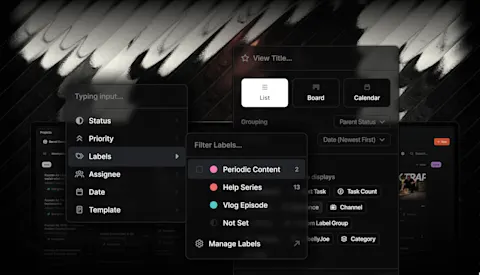
Every reel we publish already has an auto-generated transcript sitting in Clipflow's attributes panel. What we've been doing manually, and what Jack described running on his end, is pasting that transcript into Claude with a fixed prompt that outputs five overlay candidates across five formulas.
The prompt:
Help write text overlays and captions for this reel based on the transcript I provide. Here's the transcript:
[paste]
Step 1: Surface the punchline. Find the single most interesting, counterintuitive, or specific thing in the transcript and state it back to me in one sentence. This is what the video is really about.
Step 2: Write 5 text overlays for the first 1-3 seconds. Each must follow these rules:
- Add a dimension the audio doesn't carry. Don't paraphrase spoken words. Add a number, a contradiction, a complete-the-sentence, or an identity signal the audio doesn't have.
- 5-8 words max. No period in the middle. If it needs one, it's too long.
- Must pass the 1-second test: would a stranger ask "what?", "why?", or "how?" within 1 second of seeing it on mute?
- Don't invent numbers, names, or claims the transcript doesn't support. Every overlay must be defensible from what was actually said.
Use one formula per overlay:
- Bold statement: claim something the viewer might assume is wrong
- Intriguing question: frame problem with insider knowledge
- Specific outcome: promise a concrete result grounded in what the transcript actually says
- Contrarian / unpopular opinion: directly contradict standard advice
- POV realism: put the viewer inside a scenario ("POV: your top person just quit")
If the reel is advice or explainer content and POV doesn't fit, swap in Mind-blow: a number, comparison, or fact unexpected enough that the brain pauses.
Output as: punchline, then 5 numbered overlays with formula labels in brackets.
The output is five candidates, all defensible against the source transcript, all designed to pass the 1-second test. From there you pick the one that fits the reel's tone.
Not every archetype pulls equally
The five formulas are candidates to test, not a universal ranking. A specific outcome works when the transcript can support it. A question works when the question itself is unusual. A POV overlay works when the viewer can recognise the situation immediately.
We generate all five because reels tell you which archetype fits their tone. A tutorial reel doesn't want a POV overlay, a confessional reel doesn't want a specific-outcome claim, and knowing which formulas you rejected sharpens the one you ship.
Ship one, hold two, watch the hook rate
The workflow we run with the prompt output:
- Pick the strongest one for the first upload. Ship it.
- Hold the other two strongest candidates back.
- Watch the three-second retention on the published version. Clipflow now pulls this in as "hook rate" alongside the rest of your reel stats, so you don't need to open the native app.
- If it beats the baseline for comparable posts on your account, bank that shape for next time. If it falls short, test one of the held-back overlays on the next cousin reel.
Speed to first-frame matters as much as which words you pick. If the overlay isn't visible inside the first half-second and sitting in the top third of the frame where the thumb doesn't cover it, the specific words matter less than the placement.
The transcript is worth more than the overlay
The reason to run this workflow now, before the LLM step is baked into the tool, is that the same transcript unlocks captions, description text, cross-platform copy, and the next reel's script pattern. The overlay is the first output. Everything downstream from the transcript is faster because the source of truth is already text.
The teams pulling ahead on short-form right now are treating every published transcript as a small, structured dataset about what their audience actually responds to, and running the same three or four prompts against it every week. The best editor in the world can't beat that feedback loop, because the loop tells you what to shoot next.