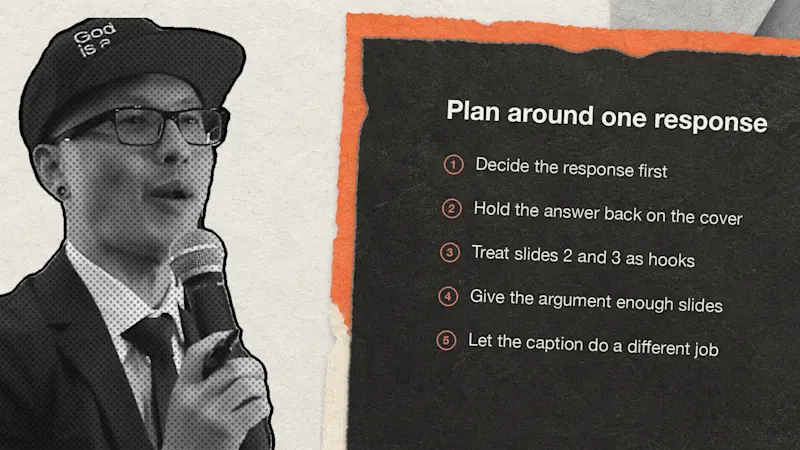
Of the last 100 carousels on @therishishine, the best drew 7,042 likes and comments and the median drew 104. Slide count doesn't explain that gap, so plan the deck around the response you want and give it only as many slides as the argument needs.
Source: The numbers come from our benchmark of 100 carousels from @therishishine, posted between July 2025 and October 2026. We ranked them by likes plus comments because Instagram shows no public view counts on carousels. The line about getting past slide 3 comes from The Futur's video on carousels, and the slide 2 advice comes from our wider review of creator advice. The cover rule, the caption rule and the 12-slide plan are ours.
Decide the response before you write a slide
The account's top posts split into two kinds, and they behaved differently.
| Deck type | Example | What it got | Comments as a share of engagement |
|---|---|---|---|
| Slogan deck | "If you're gonna go in. Go all in." | 7,042 | About 0.7% |
| Name-list deck | "If you still think carousels won't work for you, remember these names." | 1,647 | About 33 to 37% across the three |
A slogan deck gives people something to like and keep. A name-list deck gives them something to answer, and we suspect that's because they want to add a name, argue with one or tag someone.
Pick one before you start. If you want comments, the ask has to be part of the deck itself: names to remember, creators to watch, or a rule to argue with. The benchmark's advice is to avoid leaning on a caption keyword as the main comment engine, and we agree.
Make the cover promise something and hold the answer back
The account's best covers sound like rules. "If your audience don't know your story, you don't have a personal brand" drew 5,597 likes and comments, and a soft tip would have had far less to argue with.
The shapes that repeat are easy to borrow:
If you want [outcome], [uncomfortable requirement].If you still think [objection], [proof format].[Sacred cow] is what's harming your [goal].How to be [intensifier] at [skill].
We part ways with the benchmark on one point. For a how-to deck, our own rule is that the cover hints at the answer and never gives it away, because a reader who already has the answer has no reason to swipe. A rule works as a cover when the rule itself is the argument and the slides are the proof. If the deck teaches a method, promise the result and keep the method for slide 3 onwards.
Two practical rules apply to every cover. Keep the line short enough that it never wraps with one word alone on the last line, and if you're a local business, keep your street address off slide 1.
Treat slides 2 and 3 as hooks
Creators widely report that Instagram shows a carousel again to people who scrolled past it, opening on slide 2. We haven't measured that ourselves, but writing for it costs nothing. Slide 2 should make sense to a stranger who never saw slide 1, so give it a second claim instead of a line that says "let me explain".
The Futur's advice is to get people beyond slide 3, so that slide has to create momentum. Give the first concrete payoff here, and leave a reason to reach slide 4: the first item of a list with more coming, or a result that needs explaining.
Read slide 3 alone and ask whether someone would screenshot it. If the answer is no, rewrite it before you touch the rest.
Give the argument as many slides as it needs
Every top-10 post on the account ran 10 to 20 slides, and thin decks of two to seven slides almost never broke out. The median post ran 14 slides.
More slides didn't lift the median, though. In this account's numbers, the hook and the topic made the difference, and length was room for an argument that already existed.
We use these ranges:
- 8 to 10 slides for a tight list.
- 12 to 16 slides for a thesis, a proof deck or a story.
- 17 to 20 slides only when the proof needs them.
If you can't fill 12 slides with evidence, make a tighter list. In our experience, a deck padded to hit a number runs out of reasons to keep swiping.
Choose a topic with a real position
Vague mindset posts made up about 46% of this account's carousels and dominated its bottom ranks. Four formats held up better: a hot take with a proof deck, a list of names, a how-to with some edge, and a thesis about story or brand.
The test we use is whether a reader could disagree. "Keep showing up" gives nobody anything to push against. "Educational content is what's harming your brand", one of the account's top 10, gives them a reason to swipe and see the case.
Let the caption do a different job
The account's top posts barely use the caption, and the line there usually repeats the cover. The reasoning is sound: the deck carries the argument, so a long caption adds little.
Our own rule goes a little further. We keep the caption short and we don't restate the slides, so the caption adds a piece of context or a question and leaves the argument to the deck. Test both on your account, because this account's numbers show that a short caption can work without proving that a repeated cover line caused anything.
Use this 12-slide plan
This is our starting plan for a thesis deck. Adjust it to fit the argument.
| Slide | Job |
|---|---|
| 1 | Cover: the rule or the promise |
| 2 | A second standalone claim |
| 3 | The first concrete payoff, with a reason to continue |
| 4 to 9 | One piece of evidence per slide: an example, a name, a number or a before and after |
| 10 | The objection a sceptic would raise, answered |
| 11 | What to do with this tomorrow |
| 12 | The ask: save it, send it, or answer a specific question |
Say you run a bookkeeping practice and want comments. Your cover could be "If you still think your clients don't read your posts, ask them about these five." Slides 4 to 9 could name the five questions clients ask most, each with a short answer. Slide 12 would ask which question should be next.
Write that deck this week, then compare its comments with your last five carousels. If it beats them, the name-list shape is worth a second try on a different topic.