Short-form editing is getting commoditized.
UGC creators armed with iPhones routinely outperform polished agency edits and AI UGC is taking scale to another level, AI tools can auto-caption and auto-clip for pennies, and clients have been conditioned to expect $20–$30 per reel. For agencies to grow (not just survive) you’re not competing on price or craft alone.
Fundamental restructuring around lean operations, productized offers, strategic positioning, and AI-augmented workflows.
Strategy 1:
The "Hybrid Agency" Lean Contractor Model
The single killer of growing agencies is overheads. Usually from premature hiring. Full-time editors, office space, and payroll create fixed costs that collapse margins the moment a large clients churn.
The most sustainable model being endorsed by successful agency owners is a hybrid structure: one or two principals, a curated roster of freelance editors and videographers, and zero full-time employees beyond the founder(s).
How It Works in Practice
- The founder handles the top 20% of clients personally. With strategy, editing and sometimes even shooting. Then they delegate more routine projects to vetted contractors.
- Source your editors as freelancers (international where possible for salary arbitrage), paid per deliverable, and trained on a few standard "house styles" so output is consistent.
- The agency presents as a full team to clients (branded website, team photos, studio space for shoots) while remaining a single full-time employee underneath.
- Overhead risk is pushed to the client through higher per-project or retainer pricing, rather than absorbed internally.
One Australian agency owner described adding 3–4 reliable freelance videographers plus outsourced online editors, with the founder remaining the only full-time employee.
The model is safer and you can keep staffing costs scaling proportionally with revenue.
Why It Works
Service businesses struggle to scale on custom deliverables.
Added complexity (hires, office, equipment) forces higher prices but narrows the client pool.
The hybrid model sidesteps this by keeping the cost structure variable, not fixed and contractors are engaged per project and released when work dips.
A post-production producer assembles editors, motion designers, colorists, and audio specialists per job, marking up each 20% for project management.
Risks to Manage
- Freelancer quality and reliability vary; agencies need 3–4 backup editors per style to avoid bottlenecks.
- Contractors lack loyalty. Guaranteeing minimum monthly hours or volume will help retain the best talent.
- Onboarding each new freelancer is expensive without documented SOPs (see Strategy 3).
Strategy 2: Productized Service Packages
Agencies that price by the hour or per-video with vague scope invite margin erosion and scope creep. It’s also much harder to sell when you don’t have an exact package, you’re making the buyer do the heavy lifting and the customers don’t necessarily know what they need.
The emerging standard among profitable short-form agencies is productized pricing: fixed monthly packages with clearly defined deliverables, revision limits, and turnaround times.
What a Productized Short-Form Offer Looks Like
| Tier | Typical Scope | Price Range | Ideal Client |
|---|---|---|---|
| Starter | 8–12 short-form edits/month, basic captions, 1 revision round | $750–$1,500/mo | Solo creators, coaches |
| Growth | 15–20 edits/month, content calendar, hook scripting, 2 revision rounds | $2,000–$4,000/mo | Personal brands, small DTC |
| Scale | 25+ edits/month, strategy calls, A/B creative variants, repurposing across platforms | $5,000–$10,000+/mo | Funded brands, e-commerce |
Why It Scales
- Eliminate per-video pricing comparisons. Instead of competing at $20–$30 per reel against offshore editors, the agency bundles strategy, scripting, and execution into a single recurring fee.
- Rewards efficiency. If a batch of 15 edits only takes 30 hours instead of 40, your margins improves without renegotiating price.
- Predictable revenue. When 80% of monthly revenue is locked in before the month starts, hiring, tooling, and capacity decisions become rational instead of reactive.
Protecting Margins: Scope Creep
Retainer-based models are vulnerable to scope creep
"can you just add this one quick thing?" Can erode profitability quickly if you’re not paying attention.
Successful agencies document exactly what's included (and what triggers overage charges), review scope quarterly, and use per-video pricing with set revision caps (e.g., $1,000/video + 2 revisions; $350/additional revision) for project add-ons.
Strategy 3: SOPs and Systems
Every agency owner who has successfully delegated editing to contractors cites the same precondition: documented Standard Operating Procedures (SOPs) before hiring.
What to Document
- Organization: Pre-built project templates, defined folder structures so new editors can focus on editing and everything is where it needs to be (Essential!).
- Timeline organisation: Standard track layouts for turnovers so any editor can pick up another's project mid-stream increases flexibility when you don’t employ full time teams.
- Style presets: Colour management, font packs, caption styles, and motion graphics templates baked into project files so editors execute the "house look" by default, including per client specifics.
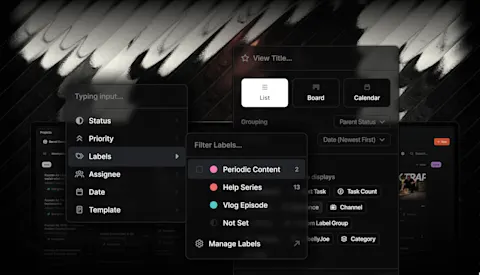
- Feedback workflows: An agency focused tool (like Clipflow) for revision requests with timestamps, eliminating feedback scattered across WhatsApp, email, and voice notes.
How to Build SOPs Efficiently
- Record everything with Loom first, then have a dedicated documentation person transcribe the key steps into concise written SOPs.
- Use your knowledgebase or Clipflow to store instructions alongside project work, not a single 40-page Google Doc that nobody reads. Break workflows into small, digestible modules that are co-located with the work as it’s being done so it can’t be missed.
- Video SOPs > text SOPs. It can be easier to record processes as video, and using a tool like loom you can transcribe and produce written instructions and link to the live video against tasks.
SOPs do double duty: they slash onboarding time for new freelancers and they function as quality-control checklists that reduce revision rounds.
You can also record SOPs for things you need from clients to reduce the amount of questions and uncertainty that can lead to client churn.
Strategy 4: Positioning Above UGC — Sell Outcomes, Not Edits
The core strategic challenge is that raw UGC-style iPhone content often outperforms polished edits in engagement and conversion. Competing on production quality alone is a losing game. Agencies overcoming this position themselves as content systems partners, not video editors.
The most important thing to remember here is that the business you’re selling to is looking for a solution to their problem, and someone to do the thinking for them. So if raw UGC performs better, you be the orchestrator and organiser of it is still more valuable than them trying to execute on it themselves.
And both types of content have a place in strong strategies.
Reframing the Offer
| Commodity Positioning | Strategic Positioning |
|---|---|
| "We edit your clips" | "We build a short-form content engine that drives [leads/sales/followers] every month" |
| Per-video pricing | Monthly retainer tied to content volume + strategy |
| Show portfolio of edits | Show growth curves over time for client channels |
| Reactive to client briefs | Proactive trend tracking, content calendars, hook scripting |
Agencies that package strategy + content calendar + execution as a single retainer are perceived as far more valuable than those selling edits by the unit.
"Think of it like McDonald's vs. a top steakhouse—both sell beef, but the perceived value is entirely different".
And taking that a step further, the top end steakhouse gets the sale regardless if they’re willing to go and get a few McDonald’s burgers for the customer.
Performance-Linked Pricing
Pure performance-based pricing (pay-per-view, pay-per-lead) rarely works because too many variables fall outside the agency's control. The product quality, sales teams, brand reputation, and algorithm.
Hybrid retainer + performance bonus model is gaining traction:
- Base retainer covers consistent output and strategy.
- Performance bonuses (tied to channel milestones, attributable leads, or revenue thresholds) reward exceptional results and keep the agency incentivised.
This model attracts more committed clients and signals confidence in outcomes.
Demonstrating Value to Reduce Churn
Client churn in content agencies is driven primarily by unclear ROI expectations and poor communication, not bad editing.
Agencies that retain clients long-term:
- Set measurable goals upfront (e.g., two-year roadmap with targets refreshed every six months).
- This is especially important, by thinking 5 steps ahead of the customer you’re immediately lengthening customer lifetime value.
- Send weekly progress highlighting outcomes (leads, engagement trends), not just effort (videos delivered).
- Conduct quarterly scope reviews to realign retainer terms with evolving client needs.
- As the clients business changes their needs will too. And if you’re not realigning they’ll find someone new who meets their new goals.
- Implement minimum contract terms (e.g., 3-month commitments) to allow enough runway for results to materialise.
- You can also hold these in reserve as part of your offer to close a deal i.e “We usually lock clients in to 3-month commitments but we’re happy to reduce this to 1 month in your case as we’re certain you’ll see outcomes within that time period”
Strategy 5: AI and Automation as a Margin Multiplier
AI isn’t replacing human editors, but it is reducing the costs of repetitive tasks, which directly improves unit economics for agencies running on thin margins.
Where AI Delivers the Biggest Time Savings
| Task | Manual Time | AI-Assisted Time | Tools |
|---|---|---|---|
| Captioning/subtitles | 30–60 min/video | 2–5 min/video | CapCut auto-captions, QuickSubs, VEED |
| Silence/filler removal | 15–30 min/video | Automatic | Descript, Opus Clip |
| Clip identification from long-form | 1–2 hours | 5–10 min | Opus Clip, Vizard.ai |
| Transcript-based editing | N/A (manual timeline) | Edit text = edit video | Descript, Capcut |
| Content repurposing (long → short) | 2–3 hours per clip | 15–30 min per batch | Repurpose.ws, Vizard, Opus |
| Scheduling + distribution | 30 min/platform | Automated | Hootsuite, Zapier integrations |
The "Long-Form to Short-Form" Repurposing Machine
One of the highest-margin services agencies are offering is systematic repurposing of long-form content (podcasts, webinars, YouTube videos) into short-form clips.
The workflow—Source → Clip Map → Cut → Package → Schedule → Iterate—can be largely automated with AI clipping tools, reducing per-clip production time to minutes rather than hours.
HubSpot's 2024 Video Marketing Report found that short-form video has the highest ROI and is the #1 format for lead generation and engagement, making this a compelling upsell for clients who already produce long-form content.
It’s also somewhere that you can be purely an organiser and service wrapped on top of tools. Yes your client could go and use opus clip themselves, but then they’d have to do it. You can package it in with your other services to increase your results, and output and pick up easy wins for the client.
Internal Margin Tools, Not a Client-Facing Product
A telling data point: one former agency employee built a SaaS tool that automates roughly 80% of the video editing process and now has 89 agencies paying for it, agencies that use it to reduce production costs internally while maintaining their client-facing billing rates.
The lesson is clear: AI savings should flow to the agency's margin, not to discounted client pricing.
Strategy 6: Niche Specialisation
Generalist "we edit videos for anyone" agencies are the most vulnerable to UGC competition and pricing pressure. Agencies that specialise in a vertical (e.g., DTC e-commerce, SaaS demos, luxury brands, health and wellness) or a service format (e.g., podcast-to-shorts repurposing, TikTok Shop content, YouTube Shorts packaging) command premium pricing because they offer domain expertise that a $25/reel freelancer cannot.
Understanding of a specific business type is hugely important. Just the other day we were looking for advertising/media buying experts. And immediately excluded e-commerce specialists over people with SaaS work examples. Because there are unique advantages and differences in every business. If you can demonstrate your experience in a niche, make sure you’re taking advantage of that.
If you don’t have examples of work in the niche you’d like to be focusing on, this is where discounting and focus can get you the case studies you need.
Examples of Niche Positioning
- Single Grain specialises in luxury brand short-form content with data-driven storytelling for affluent audiences.
- Venture Media focuses on B2B/SaaS short-form strategy with podcast production as the content engine.
- seoplus+ combines SEO strategy with short-form video production, optimising for discoverability alongside engagement.
- Cosmic Tech leverages proprietary trend analysis technology for e-commerce and retail clients.
These agencies don't compete on editing price.
They compete on understanding a specific client's business model, audience, and conversion funnel which is precisely what UGC creators and cheap offshore editors cannot replicate.
Putting It All Together:
The Sustainable Scaling Playbook
A practical sequence for agencies looking to scale without overhead explosion:
- Productize the offer. Define 2–3 fixed packages with clear deliverables, revision caps, and monthly pricing.
- Document everything. Build Loom-based SOPs and co-locate your instruction with the editing workflow, folder structure, and quality checkpoints before bringing on contractors.
- Build a freelancer bench. Recruit 3–4 editors per style, train them on house templates, and guarantee minimum monthly volume to retain the best ones.
- Automate the repetitive. Deploy AI captioning, clipping, and silence-removal tools to cut per-video production time by 40–60%. Keep the savings as margin.
- Sell strategy, not edits. Package content calendars, trend tracking, hook scripting, and performance reporting into the retainer so clients see a growth systemand don’t look at you as a standard vendor.
- Niche down. Pick a vertical or service format where deep expertise commands premium pricing and reduces competition to a handful of peers.
- Lock in committed clients. Use 3–6 month minimum contracts with hybrid retainer + performance bonus structures to stabilise revenue and reduce churn.
- Communicate relentlessly. Weekly outcome recaps and quarterly scope reviews keep clients engaged and preempt cancellation conversations.
This approach keeps fixed costs near zero (no office, no payroll beyond the founder), scales capacity linearly with revenue through contractors, and builds defensible positioning through niche expertise and strategic packaging.
These three ingredients separate agencies growing sustainably from those trapped in the edit-for-$25 commodity grind.
If you want an audit of your offer, products and service surface area fill out the form below for a complimentary ‘third party’ summary (personally reviewed by us)
If you want to reduce operational overheads and protect your margins with a platform that helps keep clients updated, editors and team working to SOPs and makes feedback and project organisation a breeze you can try Clipflow for free for 14 days.
Agencies just like yours are getting up and running in a couple of days and experiencing the purpose built different.